
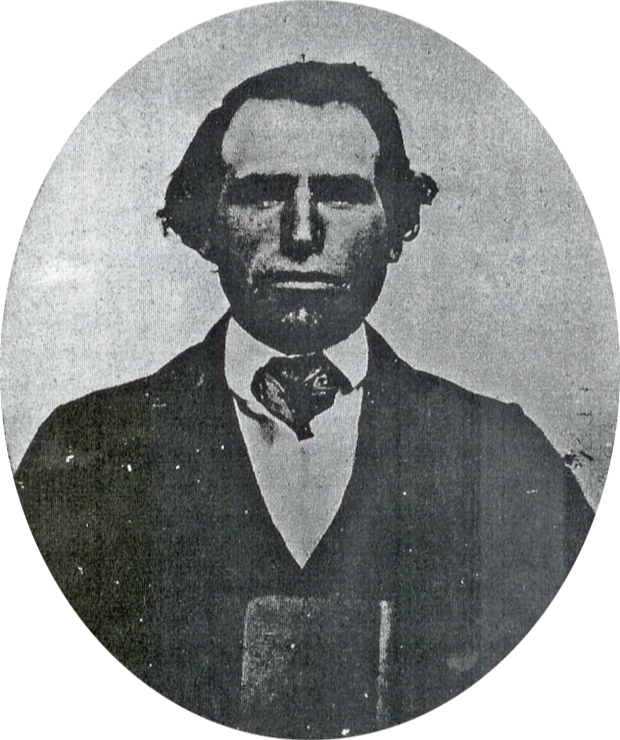
My great- great- great grandfather—through my paternal line, via my father’s mother—was Barzilla Payn (later spelled Payne) (1808-1863). In the early 1850s, about nine years after Texas achieved statehood, he moved from Paoli, Indiana, to Texas with his extended family of ten. Like many, he sought opportunities on the Texas frontier and was willing to risk the unknown to create a better life for himself and his family. Given his early service as a volunteer soldier, he was no stranger to placing himself in harm’s way, and he must have had an adventurer’s spirit.
Barzilla Payn was the son of Daniel Payn (1789-1839) and Elizabeth [Harrel] Payn (1783-1855), who married on January 22, 1806, in Caswell County, North Carolina. Records show that the couple was living in North Carolina when Barzilla was born on September 11, 1808. Barzilla had three siblings: Elizabeth Payn (1816-1900), Rice W. Payn (b. 1819), and Archy Payne (b. 1819). Sometime after 1830, the family moved to Paoli, Indiana.
In 1832, when he was twenty-four years old, he fought in the Black Hawk War as a private in Captain Moffet’s Company, 4th Regiment, 3rd Brigade, Illinois Mounted Volunteers. Upon returning to Paoli, he married Sarah Johnson (1811-1837) on April 3, 1834, and had three daughters: Matilda Ann Payn (1834-1911), Cynthia Ann Payn (1836-1913), and Sarah Elizabeth Payn (1837-1910). Barzilla’s wife died at age twenty-six on October 10, 1837, a few days after giving birth to their third daughter.
A year later, on November 8, 1838, Barzilla married Susan Jane Davis (1820-1864) in Paoli. The couple had four children: Martha Jane Payn (1839-1917), who is buried at the Payne Gap Cemetery; Evaline Constentine Payn (1841-1919), who is buried at the city cemetery, Marble Falls, Texas; John Davis Payn (1843-1863), who died from Civil War wounds and was buried in Lampasas, Texas (he never married); and Larkin W. Payn (1845-1929), who was buried in Lampasas, Texas. The 1840 U.S. Census shows that the Payn household included Barzilla as head of household and six other females: three under five years old, one between five and under ten years old, and two between fifteen and under twenty years old.

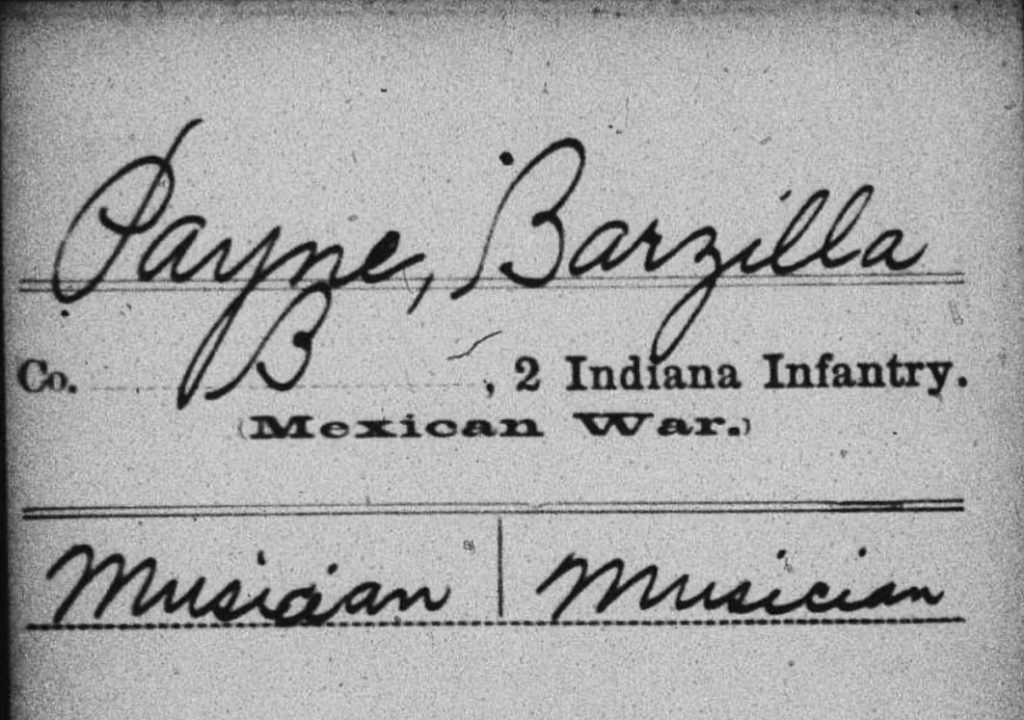
In June 1846, Barzilla again served—this time with the Indiana Volunteers during the Mexican War—joining as a private and serving as the musician of Company B, 2nd Regiment. He was mustered out on June 23, 1847, to New Orleans, Louisiana, by order of Colonel S. Churchill. Family lore suggests that Barzilla never sympathized with the Confederacy and remained a Union loyalist during the Civil War.
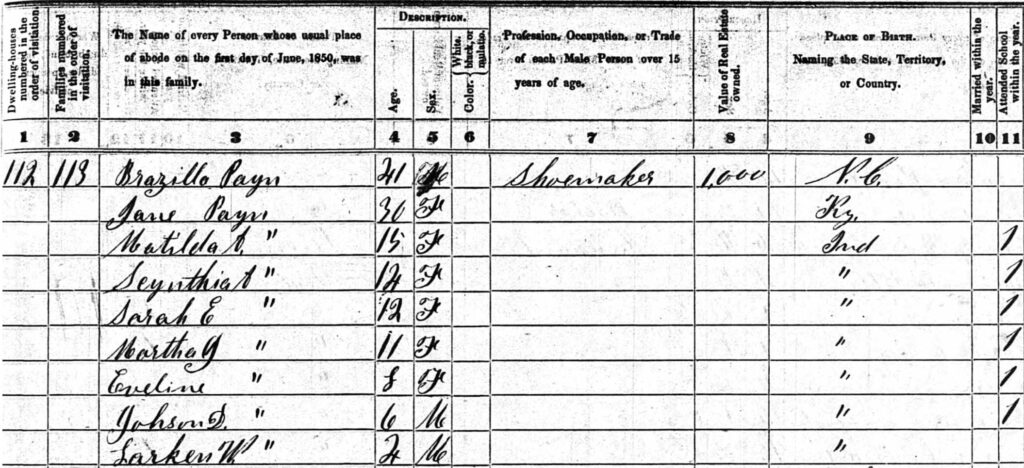
Around 1853, Barzilla and his family moved from the Orleans, Indiana and Paoli area to Texas. Barzilla and his future son-in-law, Harrison Miller (1832-1911), were drawn to business opportunities in Austin: Harrison planned to open a furniture shop, and Barzilla wanted to open a shoe store. In his youth, Barzilla apprenticed as a shoemaker, and he had a shoe shop in Orleans, Indiana, crafting work and dress shoes for men and women (he is said to have been particularly proud of his kid dress shoes). The nine-hundred mile journey by horse and wagon was hazardous and long: on a good day, they could travel about twenty miles.

The difficult journey ended in disappointment when they found out that Austin was already saturated with similar businesses. They were further disheartened by a bitter winter. They stayed in Austin for less than a year before the family moved northwest towards Lampasas County. In 1856, Barzilla settled his family into a cabin in Llano County at what likely was a company town or village related to a salt-making facility near a spring close to the Colorado River, and some of the family may have worked there. The facility is now submerged by Lake Buchanan. While his family lived and worked there, Barzilla spent time searching for land.
In 1857, he attempted to acquire 160 acres located in Lampasas County (Travis Land District, Abstract 538) by filing a preemption claim—just a year after the county had formed. The filing was unsuccessful because he did not meet the homesteading requirements, particularly the land improvement provision. A later preemption filed by William H. Phillips in 1875 for the same piece of land invalidated Barzilla’s claim. The Lampasas County surveyor, G.C. Greenwood, wrote that Phillips’ preemption “covers a dead preemption in the name of Barzella Payne and … that Barzella Payne’s preemption is and was entirely abandoned by said survey and that he left no improvements upon the same.”
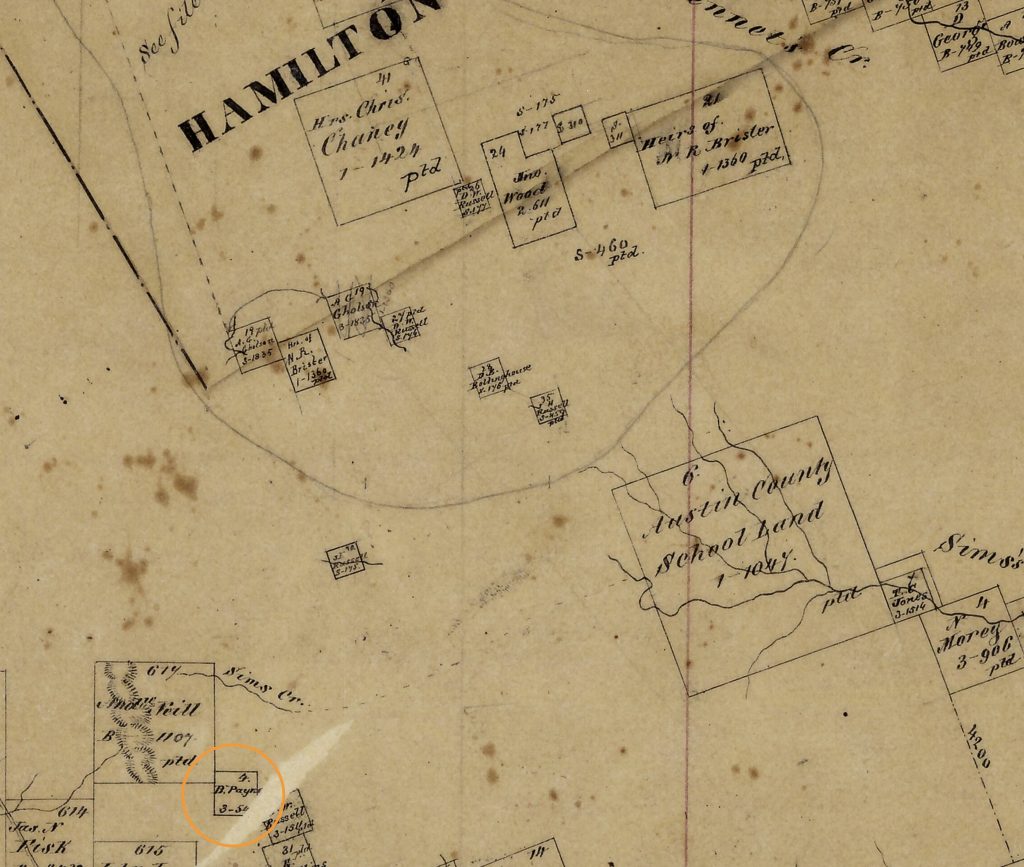
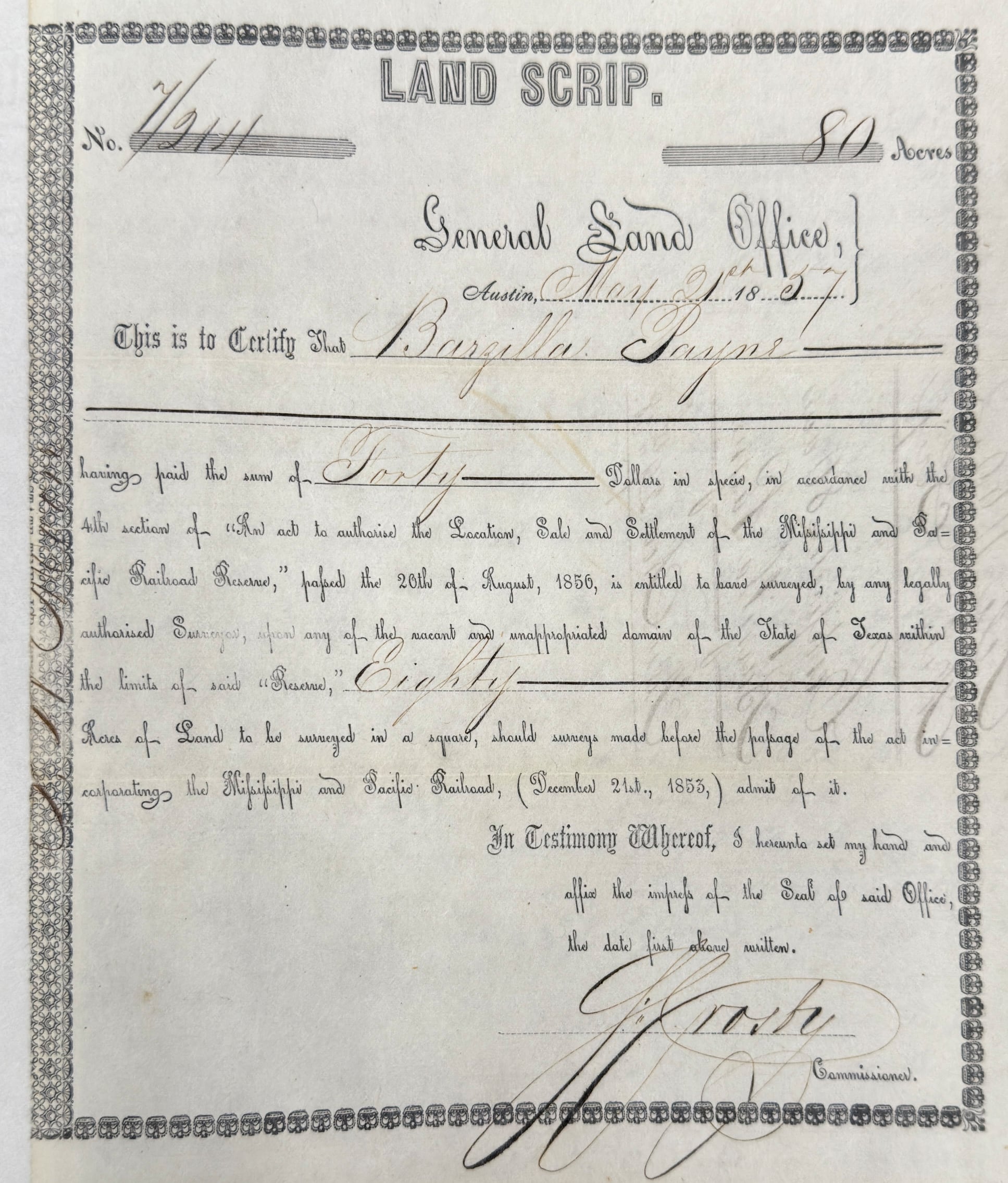
In the same year, Barzilla purchased eighty acres for forty dollars from the Texas Land Office by land scrip.1An act of the Texas legislature dated February 11, 1850 authorized the commissioner of the Texas General Land Office to issue land scrip at $.50 per acre for the liquidation of the public debt of the late Republic of Texas. This parcel, northeast of his 160-acre canceled preemption, would later be divided across counties: sixty-five acres in Mills County (created in 1887) and fifteen acres in Lampasas County (created in 1856). Barzilla also tried to enlarge his land holdings by acquiring the balance of a land credit left over from a headright certificate issued to John Wood on February 11, 1848. Barzilla attempted to use the credit, equal to 575.5 acres, to acquire a plot in Mills County near the eighty acres he had earlier purchased. In 1857 he had a survey created, but it appears that ownership of this land never transferred to Barzilla.
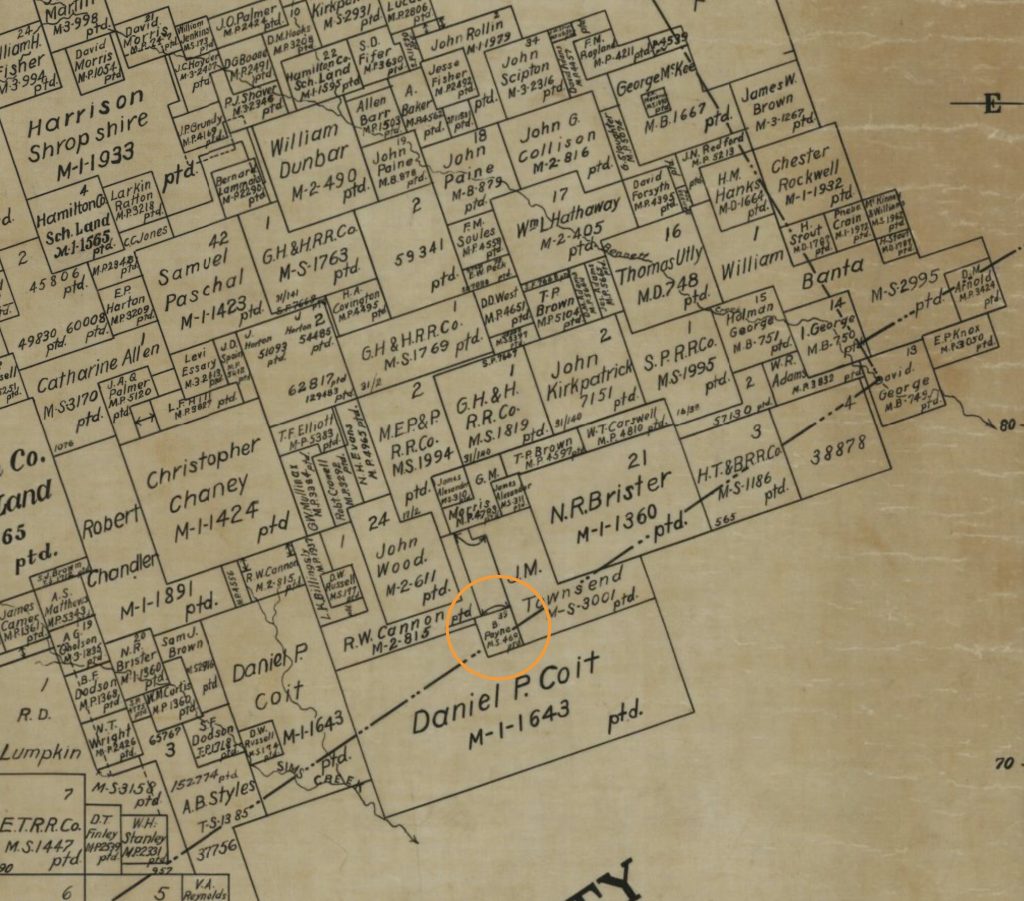
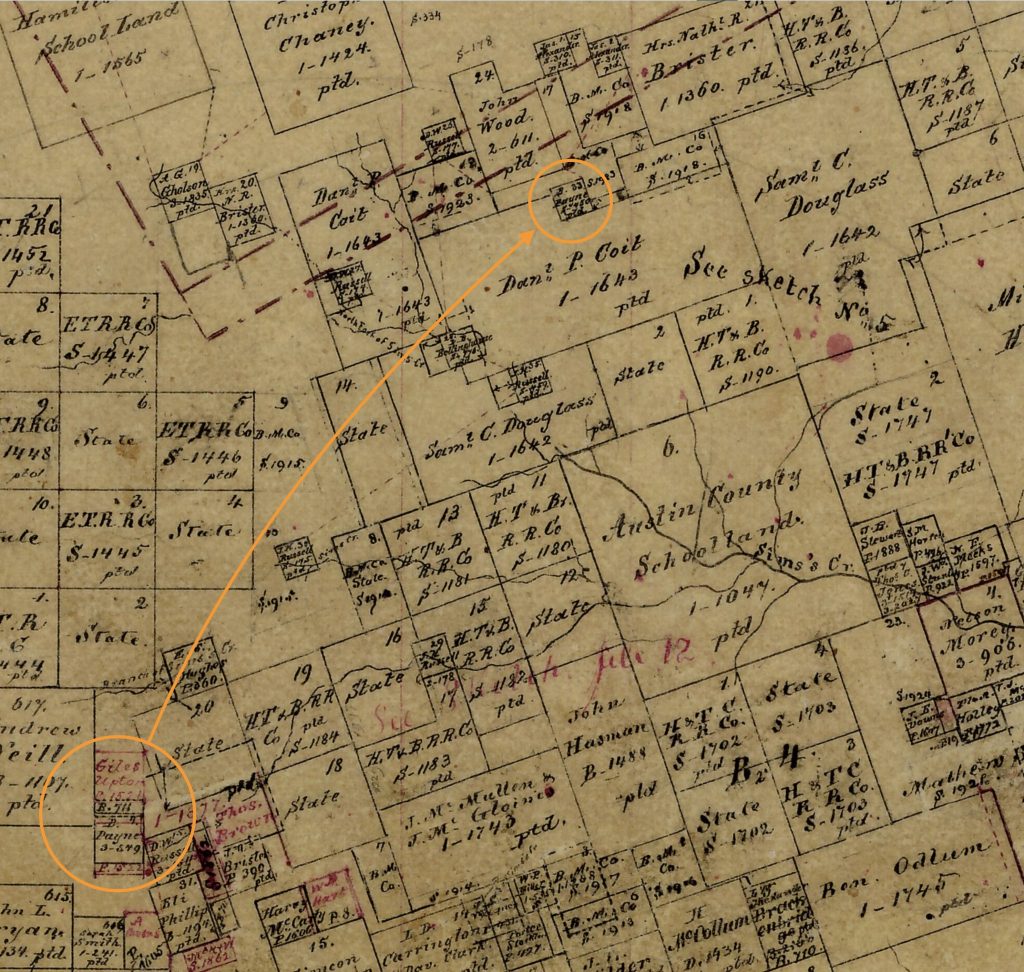
Barzilla’s eighty acres set the stage for other pioneers that followed, and eventually the small community of Payne Gap sprang up. The community grew to include a post office, which was active from 1888 through 1916, a blacksmith shop, a general store, a school, and a cemetery.
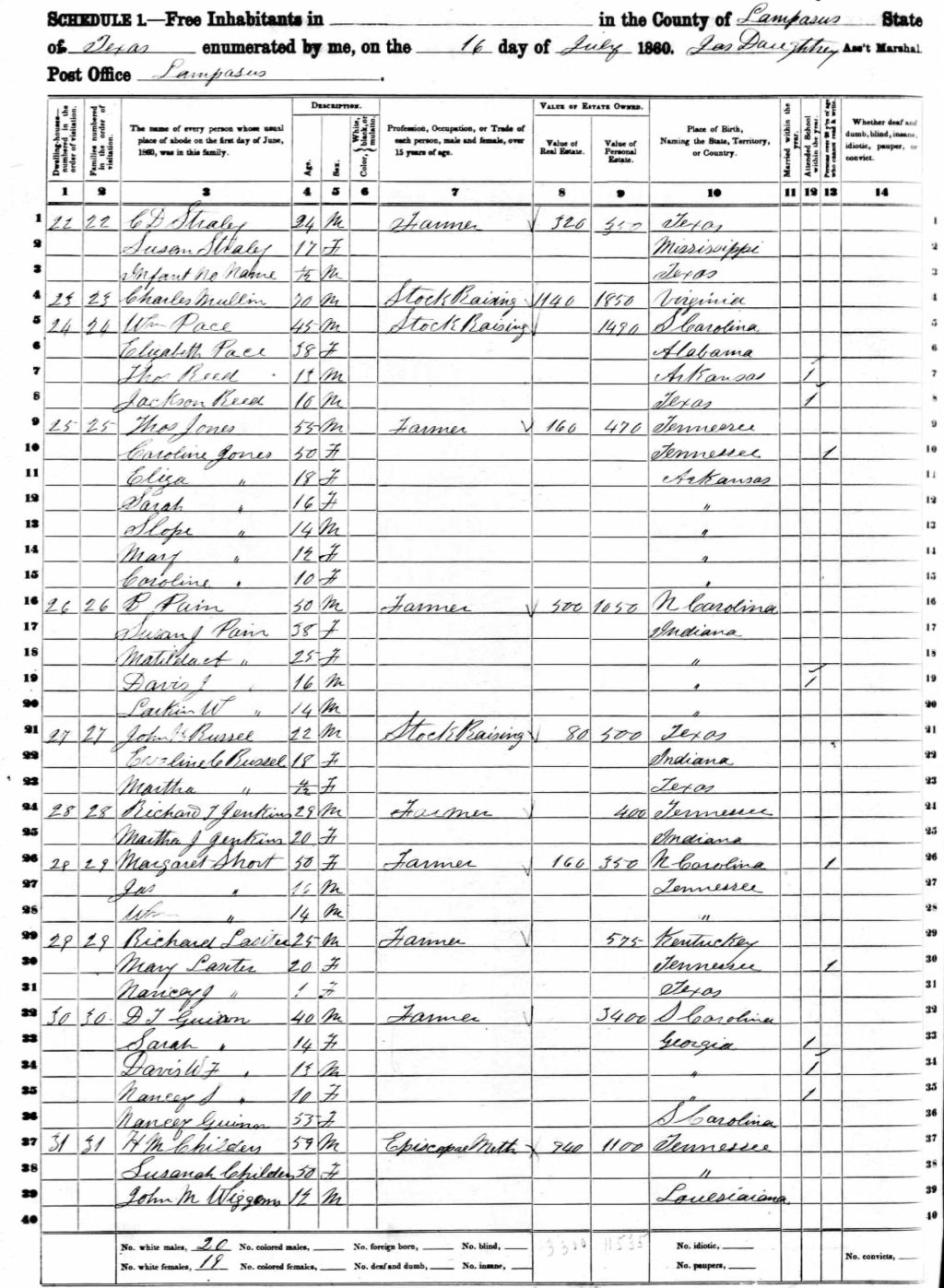
Barzilla adapted to rural life by becoming a farmer and sheep rancher. On November 28, 1863, at the age of fifty-six, at a time when Native American Indian raids were common in Central Texas, he was ambushed and scalped by the Comanche Indians while he and a negro boy were rounding up his flock of sheep. His reported last words were, “You can have me now.”
The day that Barzilla was scalped was a particularly violent day in Central Texas. Likely on the same day, a band of Comanches mutilated “Beardy” Hall near San Saba, stealing his horse, “Gray John.” “Beardy” was traveling with Mr. and Mrs. William J. Vaughn to take their daughter, Mollie, to school in San Saba. Also on the same day, the band had an encounter with Mrs. Sanford Huffstuttler and her two-year-old son near their house on Antelope Creek, but the Indians left them unharmed. Next the band tried to attack Barzilla’s son-in-law, Harrison Miller (1832-1911), who was building a stone cabin on the bank of Simm’s Creek, close to where Barzilla and his family lived. Miller was able to escape after brandishing a shotgun at the Comanches and escaping through a window. Miller and his wife, Cynthia, had recently moved from Williamson County to be near her parents. Next they attacked Barzilla, and a group pursued the Comanches, killing one native and causing the band to split apart. Later, a lone Comanche was chased and killed. The native was riding a fine horse—possibly “Beardy” Hall’s horse, “Gray John.”
Following the November raid of the Vaughn, Huffstuttler, Miller, and Payne families, a newspaper article 2San Saba News, December 11, 1941. Reprinted from the Menard News. reported that in December, after the holidays, the Comanches ambushed the Todd family, who lived near San Saba. Mr. and Mrs. Todd were taking their daughter, Alice, to school in San Saba. Mrs. Todd and a negro girl were killed. Alice, who was riding with her father on his horse, fell and was abducted, never to be seen again. Mr. Todd reportedly escaped.
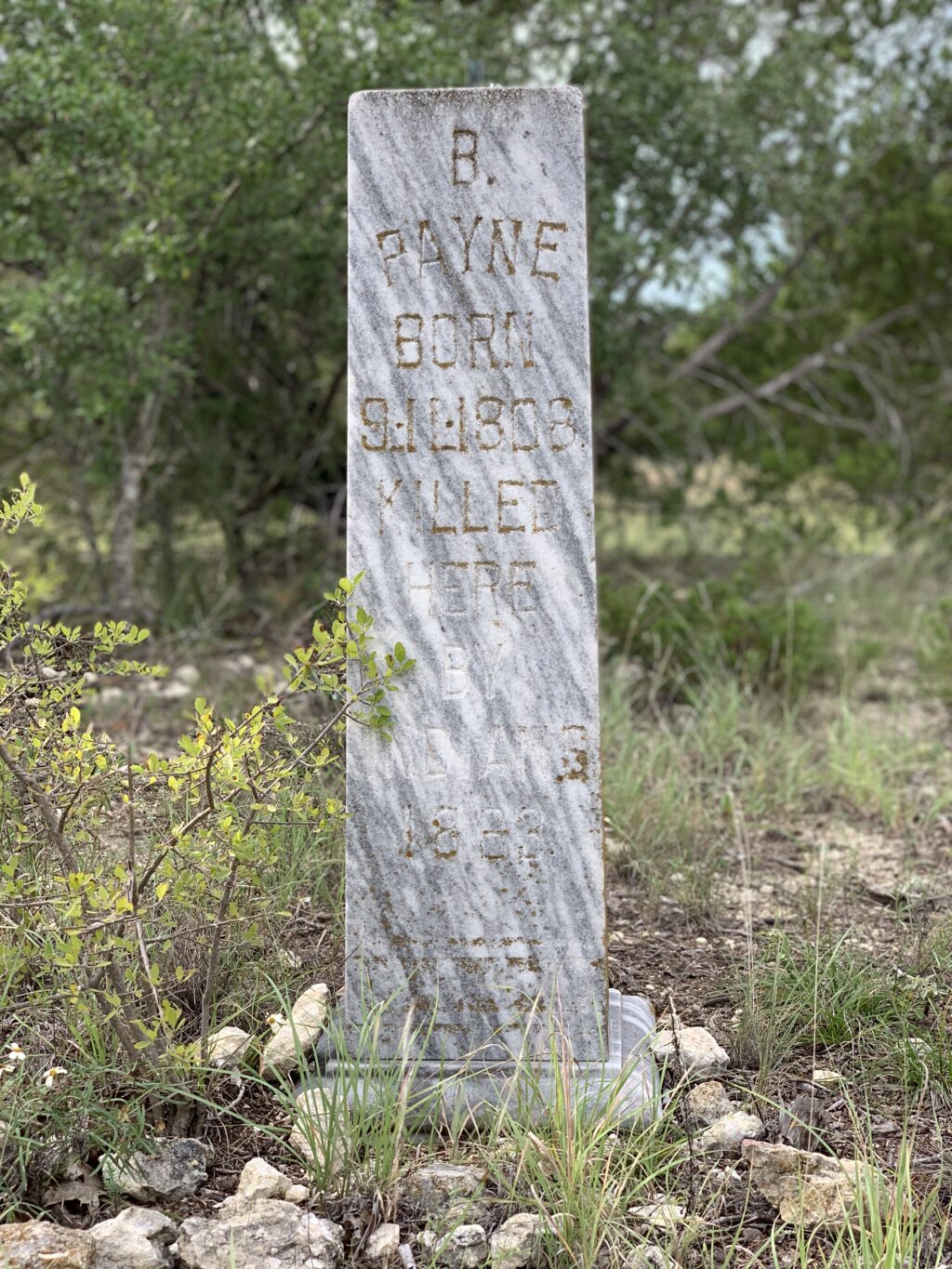
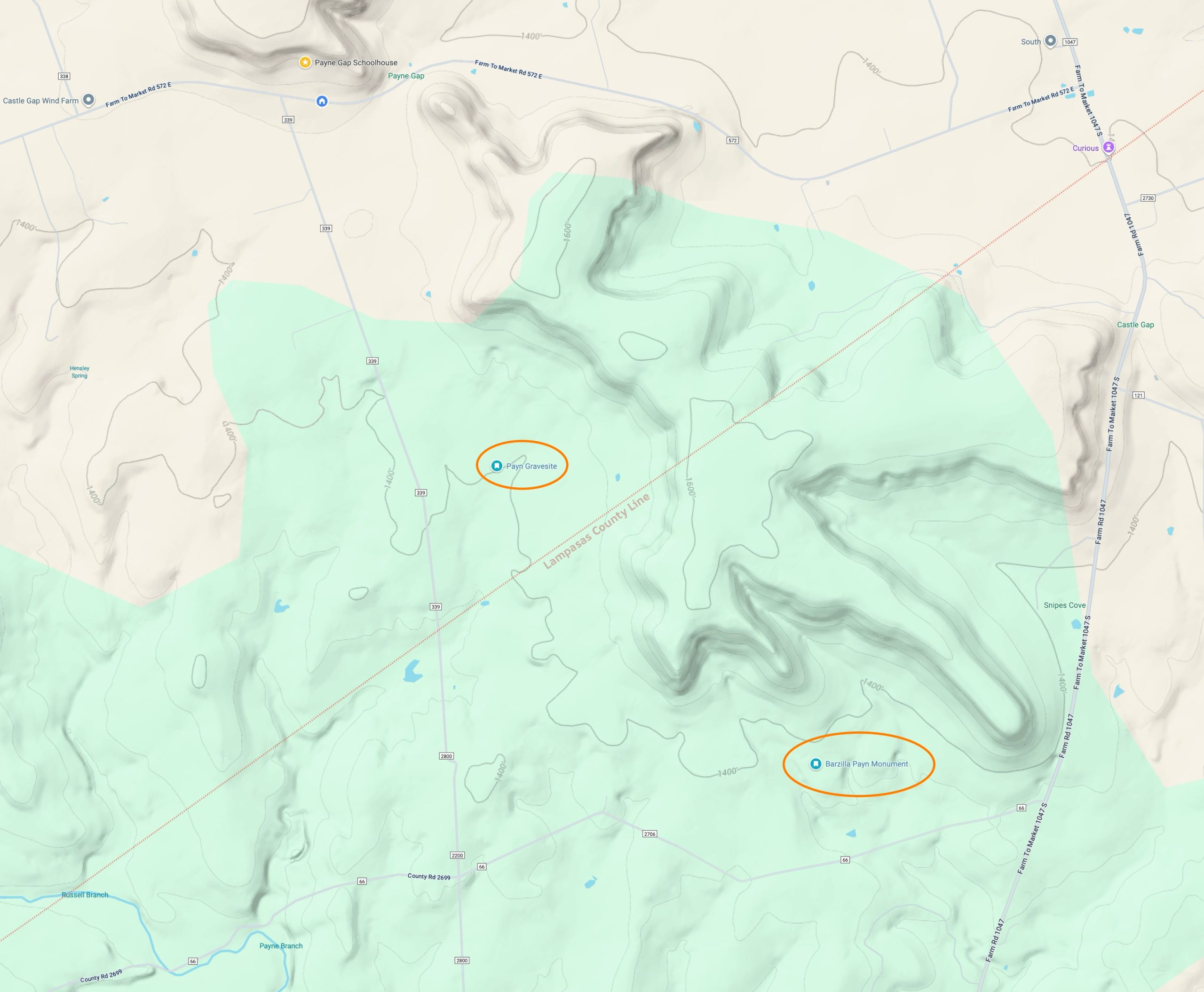
Barzilla and his wife Susan are buried at the Barzilla Payn Gravesite, located on private property owned by Ray Baird. One of is daughters, Martha Jane Payn (1839-1917), is buried at the Payne Gap Cemetery next to her husband, Richard T. Jenkins (1830-1903), Payne Gap’s first postmaster.
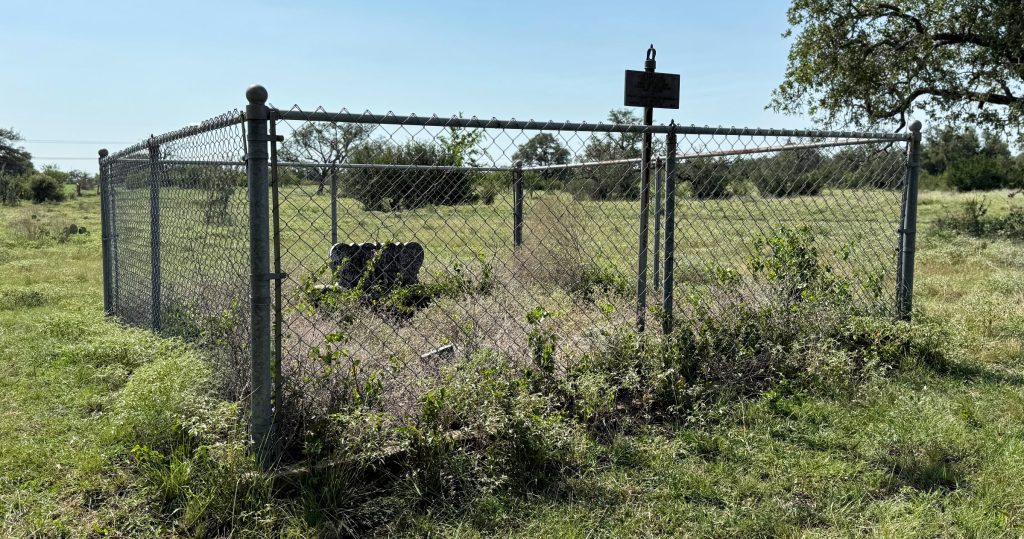
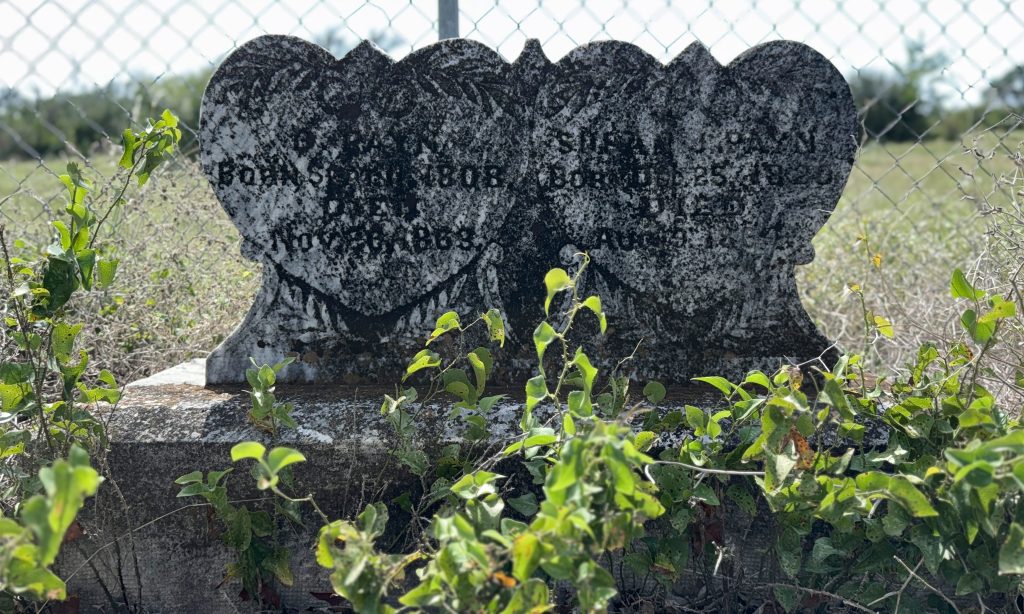
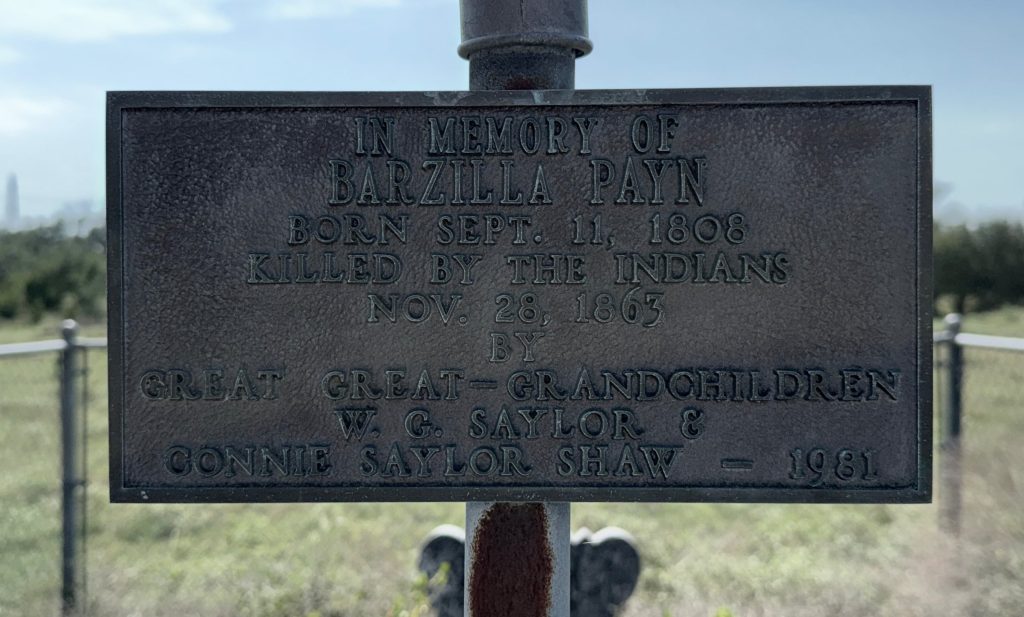
Sources Consulted
- Ancestry.com
- Blackwell, Hartal Langford. Mills County: the Way it Was (Goldthwaite, Texas: Mills County Historical Commission, 1976)
- Bowles, Flora Gatlin, ed. A No Man’s Land Becomes a County (Goldthwaite, Texas: Mills County Historical Society, 1958)
- Familysearch.org
- Lampasas County, Texas: its History and its People (Marceline, Missouri: Walsworth Publication Company, 1991)
- McConnell, Joseph Carroll. The West Texas Frontier, or, A Descriptive History of Early Times in Western Texas … (Jacksboro: Gazette Printing, 1933-1939)
- McGlothlin, N.G. Life of a Texas Pioneer Christened Payne’s Gap (Blanca, New Mexico: N.G. McGlothlin, 1932)
- Mills County Memories (Goldthwaite, Texas: Mills County Historical Commission, 1994)
- Shaw, Connie Saylor. Climbing the Family Tree (Goldthwaite, Texas: Eagle Press, 1986)
- Scroggins, Mary A. Payne and Hunt Family History (unpublished manuscript)
- Texas General Land Office digital records, with special thanks to Laurel Neuman, Research Specialist, Archives and Records
- Wilbarger, J. W. Indian Depredations in Texas: Reliable Accounts of Battles, Wars, Adventures, Forays, Murders, Massacres, etc., Together with Biographical Sketches of Many of the Most Noted Indian fighters and Frontiersmen of Texas (Austin: Hutchings Printing House, 1889)
- 1An act of the Texas legislature dated February 11, 1850 authorized the commissioner of the Texas General Land Office to issue land scrip at $.50 per acre for the liquidation of the public debt of the late Republic of Texas.
- 2San Saba News, December 11, 1941. Reprinted from the Menard News.

This is so interesting! Probably, my great-grandfather, William (Grandpa Billy) Carswell bought part of the Brister place on your map here since that designation remains on the tax records as the Brister place. A Mr. Brister is on quite a few of our records so he must have been a descendent and owner of that piece of property. I believe my dad, Aubrey W. (Pat) Carswell, bought that property from Mrs. Dave Phillips.
Patsy! Thanks for adding to the story of Payne Gap. I know the Carswells played a pivotal role in the Payne Gap/Moline stories.
Thank you, Sam! This was very well researched.
Thank you so much for this! I’ve been delving into the family ancestry more seriously lately. Barzilla is widely known in my family. Barzilla would be my four great grandfather through Larkin. My paternal grandmother was a Payne in Wichita Falls. My great aunt has photos of the graves at Payn Gap.
Hi Miranda, great to know another relative of Barzilla Payne. Wondering if you have any old photographs, maybe of Larkin? I’m on the hunt for the original daguerreotype of Barzilla, and I’m waiting to hear back from the Paoli Public Library. I sure hope that turn up something interesting. Best, Sam